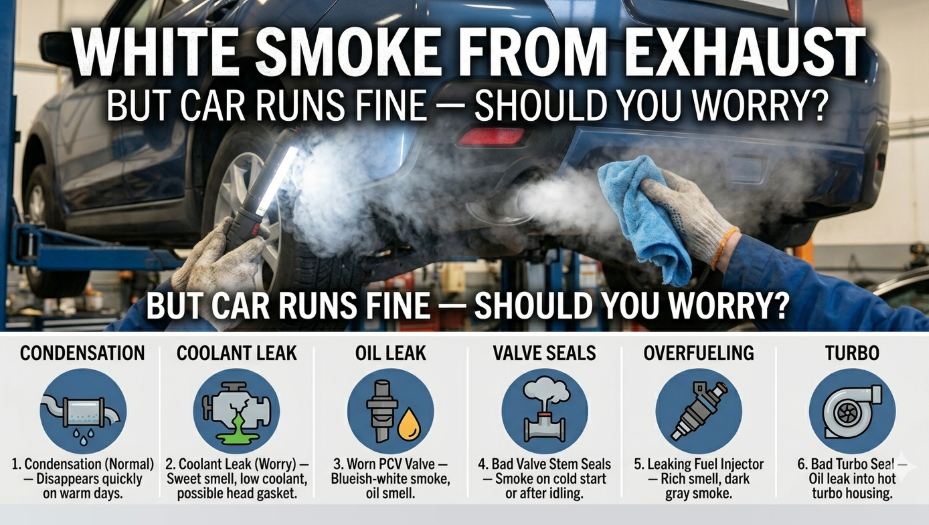
You start your car, glance in the rearview mirror, and see a cloud of white smoke pouring out of your exhaust pipe.
Your stomach drops a little. Is the engine dying? Is this expensive? Should you pull over right now?
Here’s the part that makes this confusing: the car feels totally normal. It starts fine, drives fine, no warning lights, no weird noises. Just… white smoke.
Let’s clear this up properly — because the answer genuinely depends on a few specific details, and getting it wrong in either direction (panicking over nothing, or ignoring something serious) can cost you.
First: Is It Actually White Smoke, or Something Else?
Before going further, make sure you’re looking at the right thing. Exhaust smoke comes in three colors, and each means something completely different:
- White smoke (thin, wispy, disappears quickly): Usually just water vapor — completely normal
- White smoke (thick, persistent, sweet smell): Could indicate coolant burning — needs attention
- Blue smoke: Oil burning in the engine — needs attention
- Black smoke: Excess fuel burning — needs attention
This guide focuses on white smoke specifically, since that’s the most commonly misunderstood one.
When White Smoke Is Completely Normal
Cold Mornings: Almost Always Harmless
If you see white smoke when you first start your car on a cold morning — and it disappears within a minute or two as the engine warms up — this is completely normal and not a sign of any problem.
Why it happens: Your exhaust system naturally collects condensation (water vapor) overnight, especially in cold or humid weather. When you start the engine, that water vapor heats up and turns to a light, wispy white cloud — basically the same thing as your breath turning visible on a cold day.
How to tell it’s just condensation:
- It happens mainly in cold weather or after the car has been sitting for hours
- It’s thin and dissipates quickly, usually within 1–2 minutes of driving
- It doesn’t have a strong or sweet smell
- It doesn’t come back once the engine is warmed up
- Your car runs completely normally — no rough idle, no warning lights, no performance issues
If this matches what you’re seeing, you can stop worrying. This happens to gas and diesel vehicles alike and is one of the most common “scary but harmless” car symptoms there is.
When White Smoke Means Something’s Wrong
Now here’s where it matters to pay closer attention. If any of these apply, it’s worth investigating further — even if the car still feels fine to drive.
Warning Sign 1: The Smoke Doesn’t Go Away
If white smoke continues well after the engine is warmed up — not just at startup, but consistently while driving — that’s a different story than simple condensation.
Warning Sign 2: Thick, Persistent Smoke
Condensation smoke is thin and wispy. If what you’re seeing is thick, billowing, and constant, that’s more likely a sign of coolant entering the combustion chamber — usually from a blown head gasket, a cracked cylinder head, or in rarer cases a cracked engine block.
Warning Sign 3: A Sweet Smell
This is one of the most reliable warning signs. Burning coolant has a distinct sweet smell (coolant contains ethylene glycol, which smells sweet when burned) — very different from the neutral smell of water vapor.
If you notice a sweet smell along with the white smoke, this points strongly toward a coolant leak into the engine.
Warning Sign 4: Your Coolant Level Keeps Dropping
If you find yourself topping up coolant more often than you used to, with no visible external leak (no puddles under the car, no wet spots), the coolant may be disappearing into the engine and burning off as that thick white smoke.
Warning Sign 5: Overheating or Rough Running
Even if your car “runs fine” right now, keep an eye on your temperature gauge. A head gasket issue often starts subtle but can progress to overheating, rough idling, or loss of power over time.
Why Your Car Can “Run Fine” Even With a Real Problem
This is the part that confuses a lot of people — and it’s worth explaining clearly.
A blown head gasket or coolant leak doesn’t always cause immediate, obvious symptoms. In the early stages, you might only notice:
- White smoke (the main symptom)
- A faint sweet smell, easy to miss
- Slightly lower coolant level over time
Your engine can keep running relatively normally for a while even as this problem develops — which is exactly why people get caught off guard later when it suddenly turns into overheating or a complete engine failure.
In other words: “runs fine” doesn’t mean “is fine.” It just means the problem hasn’t progressed far enough yet to cause obvious performance issues.
Quick Diagnostic Checklist
| What You’re Seeing | Likely Cause |
|---|---|
| Thin white smoke, only at cold startup, gone within 1-2 min | Normal condensation — no action needed |
| Thick white smoke, doesn’t go away, even when warm | Possible coolant leak / head gasket |
| Sweet smell with the smoke | Strong sign of coolant burning |
| Coolant level dropping with no visible leak | Coolant likely entering the engine |
| White smoke + overheating or rough idle | Get it checked soon — don’t delay |
| White smoke only in very cold weather, disappears as car warms | Normal — common in cold climates |
What to Do If You Suspect a Coolant Leak
If you’re seeing the warning signs above, here’s a sensible next step — without jumping straight to “you need a new engine”:
- Check your coolant level when the engine is cold (never open the coolant reservoir on a hot engine)
- Check for white residue or oil that looks milky on the oil dipstick — this is another classic sign of coolant mixing with oil
- Watch your temperature gauge closely for the next few drives
- Get a pressure test done by a mechanic — this is a simple, inexpensive test that can confirm whether coolant is leaking internally
- Don’t keep driving long distances if you suspect this — while a small leak might not cause immediate failure, ignoring it risks turning a moderate repair into a full engine rebuild
How Much Does It Cost to Fix?
This varies a lot depending on the actual cause:
- If it’s just condensation: $0 — no repair needed
- Head gasket replacement: Typically $1,000–$2,500 depending on the vehicle, since it’s labor-intensive
- Cracked cylinder head: Can range from $500–$1,200 for the part alone, plus labor
- Cracked engine block: Often more cost-effective to replace the engine than repair it, particularly on older vehicles
This is exactly why catching the issue early — at the “white smoke but car runs fine” stage — matters so much. The cost difference between an early diagnosis and a fully overheated, seized engine is significant.
Frequently Asked Questions
Q: Is white smoke from the exhaust always bad?
A: No. Thin white smoke that appears briefly on cold mornings and disappears as the engine warms up is just condensation and is completely normal.
Q: How do I know if white smoke is from coolant or just condensation?
A: Condensation smoke is thin, appears mainly in cold weather, and disappears within a minute or two. Coolant-related smoke is thicker, more persistent, often has a sweet smell, and doesn’t go away as the engine warms up.
Q: Can I keep driving if I see white smoke?
A: If it’s clearly just cold-weather condensation, yes — it’s harmless. If the smoke is thick, persistent, or smells sweet, it’s best to get it checked soon rather than continuing to drive long distances, as the underlying cause could worsen.
Q: Why does my car run fine but still produce white smoke?
A: Issues like a developing head gasket leak don’t always cause immediate performance problems. The engine can run relatively normally in the early stages even as coolant slowly enters the combustion chamber, which is why the smoke is often the only noticeable symptom at first.
Q: Does white smoke mean I need a new engine?
A: Not necessarily. Many cases are resolved with a head gasket replacement or addressing a coolant leak, which is far less expensive than a new engine. Catching the issue early significantly improves your options and reduces cost.
Q: Why does white smoke happen more in winter?
A: Cold, humid air increases condensation buildup in the exhaust system overnight. This is why cold-weather white smoke at startup is one of the most common — and most harmless — versions of this symptom.
Final Thoughts
White smoke from your exhaust isn’t automatically a reason to panic — but it’s also not something to wave off without checking the details. The difference between “nothing to worry about” and “get this checked soon” comes down to a few simple things: how thick the smoke is, whether it lingers, whether there’s a sweet smell, and whether your coolant level is staying steady.
If you’ve gone through the checklist above and it points toward a cold-weather condensation pattern, relax — your car is fine. If it points toward coolant burning, don’t wait for “runs fine” to turn into “won’t start” — a quick pressure test from a mechanic now can save you a much bigger repair bill later.