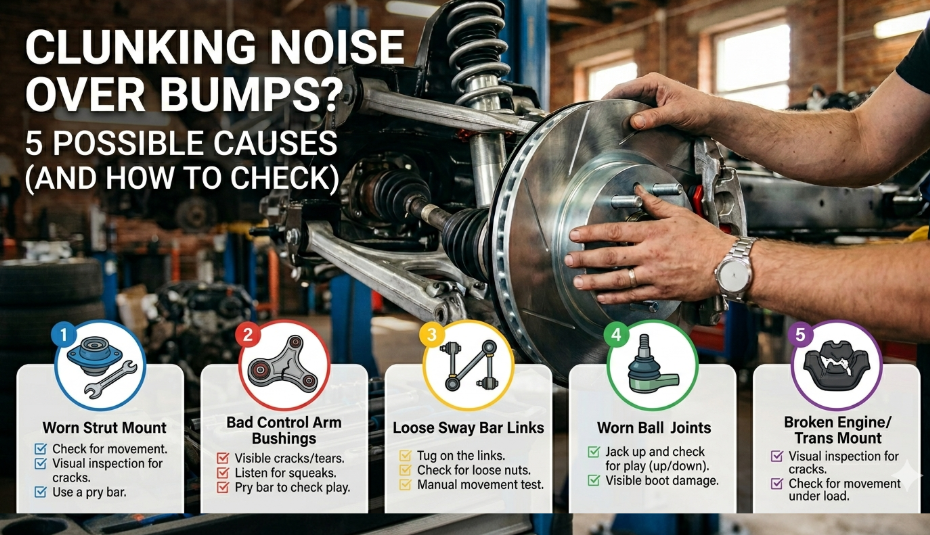
You hit a small bump — a pothole, a speed bump, even just a slightly uneven patch of road — and you hear it: clunk.
It’s not loud enough to panic about, but it’s not normal either. And once you notice it, you can’t stop noticing it. Every bump, every pothole, every driveway — clunk.
Here’s the good news: a clunking noise over bumps almost always comes from your suspension system, and in most cases, it’s something you can diagnose yourself with a flashlight and 10 minutes — before you ever pay a mechanic just to look.
Let’s go through the 5 most common causes, starting with the most likely one.
Why Does My Car Clunk Over Bumps?
Your suspension system is made up of dozens of moving parts — bushings, links, joints, mounts — all designed to absorb shock and let your wheels move independently of the car’s frame.
When one of those parts wears out, loosens, or breaks, it can’t absorb the impact smoothly anymore. Instead of a soft “thud,” you get a sharp “clunk” as metal parts knock against each other or against their mounting points.
The clunk is your car telling you something has gone from “tight and controlled” to “loose and knocking.”
Cause 1: Worn Sway Bar Links (Most Common Cause)
This is, by far, the most common reason for a clunking noise over bumps — especially if the clunk happens on small, sharp bumps rather than big dips.
What it is: Sway bar links (also called stabilizer links) connect your sway bar to the suspension. They have small rubber or plastic bushings at each end that wear out over time.
How to check:
- Park the car and locate the sway bar links (they run from the suspension up to the sway bar — a thin metal rod that runs side to side under the car)
- Try wiggling the link by hand (with the car safely supported)
- If it moves more than it should, or you can hear a clicking sound, that’s your culprit
Cost to fix: Sway bar links are one of the cheapest suspension parts to replace — usually $30–$80 for parts, and most mechanics can do it in under an hour.
Cause 2: Worn Strut Mounts or Bushings
What it is: Your struts (or shocks) connect to the car’s body through a mount with a rubber bushing inside. Over time, this rubber degrades, cracks, or separates — causing a clunk every time the strut moves up and down over a bump.
How to check:
- Push down firmly on each corner of the car and let go (the “bounce test”)
- A clunk or knock as the car rebounds usually points to the strut mount
- You can also have a helper drive slowly over a curb edge while you listen from outside the car — you’ll often hear exactly which corner is making noise
Cost to fix: Strut mounts typically run $50–$150 per side for parts, depending on the vehicle, plus labor.
Cause 3: Loose or Worn Control Arm Bushings
What it is: Control arms connect your wheels to the car’s frame and allow them to move up and down. Each control arm has bushings at the pivot points — and when these wear out, you get play (looseness) that causes a clunk on bumps, especially when turning at the same time.
How to check:
- This one’s harder to spot visually, but a common sign is the clunk being more noticeable when turning over a bump (like turning into a driveway with a dip)
- A mechanic can check this quickly with a pry bar test on a lift — if you’re not confident inspecting it yourself, this is one to mention specifically when you take it in
Cost to fix: Control arm bushings can be replaced individually, but it’s often more cost-effective to replace the entire control arm assembly — typically $80–$250 per side.
Cause 4: Worn End Links or Ball Joints
What it is: Ball joints allow your wheels to pivot for steering while also moving up and down with the suspension. When they wear out, they develop play — and that play turns into a clunk over bumps.
How to check:
- This is a safety-critical part, so be careful: a badly worn ball joint can fail completely, which is dangerous
- Warning signs include: clunking that’s worse when turning, uneven tire wear, or a steering wheel that feels “loose”
- If you suspect a ball joint, get it inspected by a mechanic rather than testing it yourself — this isn’t one to gamble on
Cost to fix: Ball joints range from $50–$200 per side for parts, plus labor. If they’re showing serious wear, don’t delay this repair.
Cause 5: Loose Heat Shields or Exhaust Components
What it is: This one’s less serious but still annoying. Heat shields (thin metal covers around your exhaust) can loosen over time, vibrate, and clunk or rattle when you go over a bump.
How to check:
- This noise usually sounds more like a rattle or light bang from underneath the car, rather than a sharp clunk from the wheels
- Look underneath your car (or have a mechanic check) for any loose metal shields near the exhaust pipe
- Sometimes a quick zip-tie or clamp fix is all it needs
Cost to fix: Often free or under $20 if it just needs to be re-secured. No major repair needed.
Quick Diagnostic Checklist
Use this simple checklist to narrow down the cause before you go to a mechanic:
| Symptom | Likely Cause |
|---|---|
| Clunk on small, sharp bumps | Sway bar links |
| Clunk when pushing down on the car (bounce test) | Strut mounts |
| Clunk worse when turning over a bump | Control arm bushings or ball joints |
| Steering feels loose + clunking | Ball joints (get checked soon) |
| Rattling/banging sound from underneath, not from wheels | Heat shield |
Should You Worry About This?
Most causes of clunking over bumps — sway bar links, strut mounts, heat shields — are not urgent safety issues. They’re annoying, but your car is still safe to drive in the short term.
The one exception is ball joints. If you notice the clunk getting worse along with a loose-feeling steering wheel, uneven tire wear, or the car pulling to one side, get it checked out sooner rather than later. A failed ball joint can cause loss of steering control.
For everything else, it’s safe to drive while you schedule a repair — just don’t ignore it indefinitely, since worn suspension parts tend to wear out the parts around them faster too.
How Much Will It Cost to Fix a Clunking Noise?
Here’s a realistic price range based on the most common causes:
- Sway bar links: $30–$80 (parts) + 30–60 min labor
- Strut mounts: $50–$150 per side + 1–2 hours labor
- Control arm bushings/assembly: $80–$250 per side + 1–2 hours labor
- Ball joints: $50–$200 per side + 1–2 hours labor
- Heat shield: $0–$20, often a quick fix
Most clunking noise repairs fall in the $100–$300 range total — not a budget-breaker, especially compared to letting the issue worsen and damage other parts.
Frequently Asked Questions
Q: Is it safe to drive with a clunking noise over bumps?
A: In most cases, yes — for a short period. Sway bar links and strut mounts are not urgent. However, if the clunk is accompanied by loose steering or pulling to one side, get it checked promptly, as it could indicate a ball joint issue.
Q: Why does my car only clunk over small bumps, not big ones?
A: This pattern is classic for worn sway bar links. They handle smaller, sharper impacts and tend to clunk on minor road imperfections rather than big dips.
Q: Can I fix a clunking noise myself?
A: Sway bar links and heat shields are beginner-friendly DIY fixes if you’re comfortable with basic tools. Strut mounts, control arms, and ball joints are more involved and often safer to leave to a mechanic, especially ball joints due to safety concerns.
Q: Will an alignment fix a clunking noise?
A: No. An alignment adjusts the angle of your wheels but doesn’t address worn or loose suspension parts. If you’re hearing a clunk, you need a suspension inspection, not just an alignment.
Q: How long can I drive with worn sway bar links?
A: Sway bar links aren’t typically a safety-critical part, so you can usually drive for a while without fixing them. That said, they’re cheap to replace, so there’s little reason to put it off.
Final Thoughts
A clunking noise over bumps is one of those issues that’s easy to diagnose once you know what to listen for and where to look. In most cases, it’s a worn sway bar link or strut mount — both relatively inexpensive, straightforward fixes.
The key is not ignoring it. Worn suspension parts put extra stress on the parts around them, turning a $50 fix into a $300 one if left too long.
If you’ve gone through the checklist above and you’re still not sure what’s causing the clunk, it’s worth a quick visit to a trusted mechanic — describing exactly when the clunk happens (small bumps vs big bumps, turning vs straight) will help them diagnose it faster.