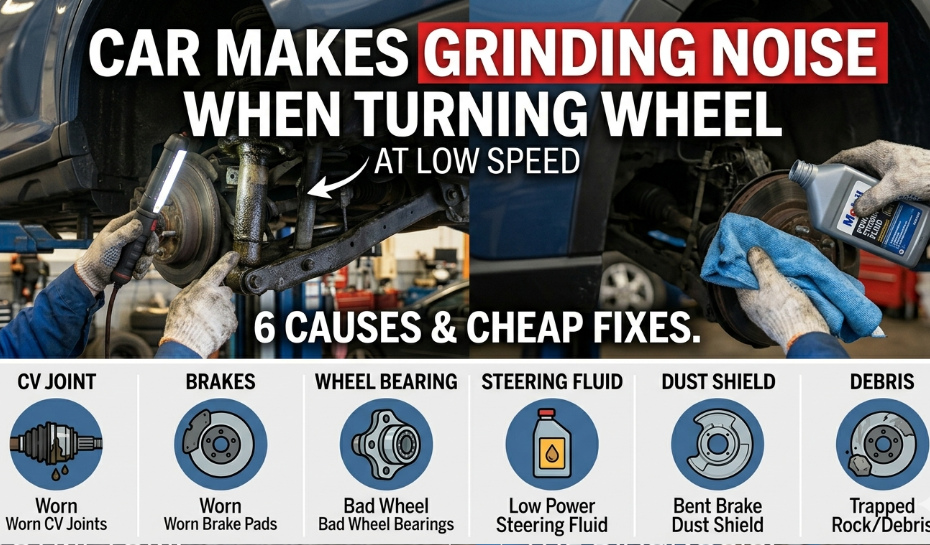
You’re pulling into a parking lot, turning the wheel at a crawl, and there it is — that unmistakable grinding sound. It’s not loud on the highway, it’s not there when you’re driving straight, but the second you turn the wheel at low speed, it shows up. If this is happening to you, you’re not alone, and in most cases it’s not as expensive to fix as it sounds.
Below are the six most common reasons your car grinds when turning at low speed, how to tell them apart, and which ones you can actually deal with yourself before paying a shop.
1. A Worn or Failing CV Joint
If your car is front-wheel drive (most cars on the road today), the constant velocity (CV) joints in your front axles are usually suspect number one. A CV joint that’s losing its grease or developing wear will often produce a clicking or grinding noise that gets noticeably worse when you turn the wheel sharply at low speed, like backing out of a driveway or pulling into a tight parking spot.
How to check: Turn the wheel all the way to one lock, then slowly drive in a tight circle. If the noise gets louder, especially on one side, that side’s CV joint (or its boot) is likely the culprit. Inspect the rubber CV boot near the wheel — if it’s torn or you see grease flung around the inside of the wheel, that confirms it.
Cheap fix: A torn boot caught early can sometimes be replaced for a fraction of the cost of a full joint. Wait too long, though, and dirt gets into the joint itself, and you’re looking at a full axle replacement.
2. A Failing Wheel Bearing
Wheel bearings tend to announce themselves with a low grinding or growling sound that changes pitch with your speed, and gets louder or quieter depending on which way you turn. This is one of the more common reasons for the kind of noise we covered in Car Shakes When Idle But Drives Fine – 7 Cheap Fixes, since a bad bearing can also cause vibration once it’s worn enough.
How to check: With the car safely jacked up and the wheel off the ground, grab the tire at the 12 and 6 o’clock positions and try to rock it. Noticeable play usually means a bad bearing.
Cheap fix: Most modern cars use a sealed wheel bearing hub assembly, which isn’t a DIY-cheap repair, but catching it early avoids damage to the ABS sensor and hub, which turns a moderate repair into a much pricier one.
3. Low or Old Power Steering Fluid
This one’s an easy first check because it costs nothing. Low, dirty, or aerated power steering fluid causes the pump to grind or whine, especially when you’re turning the wheel fully at low speed (like parking), since that’s when the pump works hardest.
How to check: Pop the hood and check your power steering fluid reservoir against the fill lines. If it’s low, dark, or smells burnt, that’s your answer.
Cheap fix: Top off or flush the fluid. This is genuinely one of the cheapest fixes on this list — sometimes under $20 in fluid.
4. Worn Strut Mounts or Bearings
The strut mount sits at the top of your suspension strut and lets the whole assembly pivot smoothly when you turn the wheel. When it wears out, it can produce a grinding or clunking noise specifically when turning at low speed, even though the car drives fine in a straight line.
If you’ve already read our guide on suspension symptoms, this is one of the trickier ones to diagnose without a lift, because the noise can be mistaken for a CV joint issue.
How to check: With the car parked, turn the wheel lock to lock while a second person listens near the strut tower under the hood (engine off). A grinding or clunking sound localized there points to the mount.
Cheap fix: Strut mounts are a moderate DIY job if you’re comfortable with spring compressors, but if that’s not your thing, it’s a fairly quick job for a shop compared to a full strut replacement.
5. Worn Ball Joints or Tie Rod Ends
These steering and suspension components connect your wheels to the rest of the car and let them turn. When they wear out, you’ll often hear a grinding or clunking sound when turning, particularly over bumps or at low speed in parking lots.
How to check: With the car on a jack stand, grab the tire at 3 and 9 o’clock and try to rock it side to side (different from the wheel bearing check, which is top/bottom). Excess play points to a tie rod or ball joint issue.
Cheap fix: Individual tie rod ends are relatively inexpensive parts, but they do need an alignment afterward, so factor that into the cost.
6. Debris or Worn Brake Components
Sometimes the “turning grind” isn’t a steering part at all — it’s a small rock or piece of debris stuck between the brake shield and rotor, or a brake pad that’s worn down to its metal wear indicator. Either can create a grinding sound that seems to change with steering input simply because of how the wheel moves relative to the noise source.
How to check: Look through the wheel spokes at the brake rotor and pad for visible debris, and check pad thickness if you can see it.
Cheap fix: This is genuinely the cheapest possible fix on the list — sometimes it’s just a pebble you can knock out with a flashlight and a screwdriver.
Quick Fixes You Can Try at Home Today
- Check and top off power steering fluid (5 minutes, almost free)
- Visually inspect CV boots for tears or flung grease
- Look through the wheel spokes for debris near the brake rotor
- Rock each wheel top-to-bottom (bearing) and side-to-side (tie rod/ball joint) while jacked up
- Listen for the noise with the hood up, wheel turned, engine off, to localize it to the steering pump or strut tower
When It’s Time to See a Mechanic
If you’ve ruled out fluid and debris and the noise is still there, don’t keep driving on it. CV joints, bearings, and suspension components are safety-related parts — when one fails completely, you can lose the ability to steer or keep a wheel attached. A shop visit at this stage is far cheaper than what happens if a worn part fails on the road.
FAQ
Is it safe to drive with a grinding noise when turning?
For a short distance at low speed, usually yes, but it’s not something to ignore for long. Steering and suspension parts are safety-critical, so get it diagnosed within a few days rather than weeks.
Why does the noise only happen at low speed, not on the highway?
Most of these parts (CV joints, ball joints, strut mounts) see their hardest workload when the wheel is turned at a sharp angle, which mostly happens at parking-lot speeds, not highway cruising.
Can a wheel alignment fix a grinding noise?
No. Alignment affects tire wear and how the car tracks, but it won’t fix a worn part. If anything, a shop will usually need to realign after replacing a tie rod or ball joint.