


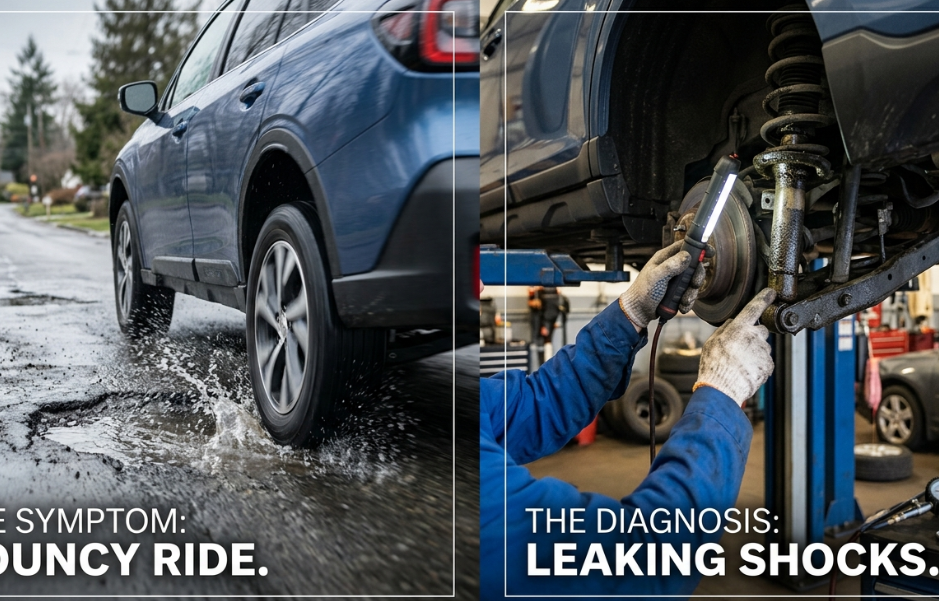
You hit a pothole, heard a thud, and now your car feels… different. Maybe it bounces a little too much over the next few bumps, or it feels floaty and unsettled on the highway, like the front end is wallowing instead of staying flat. That’s a classic sign your shocks (or struts) took the hit and may be on their way out.
The good news is you don’t need a lift or a mechanic’s eye to get a strong read on this. Here’s how to tell if your shocks are actually blown, and what to do about it.
What “Blown” Actually Means
A shock absorber’s job is to control the spring’s movement, so your car settles after a bump instead of continuing to bounce. When a shock is blown, the internal seal has failed, usually leaking hydraulic fluid, and it can no longer resist that motion properly. The spring is still doing its job, but nothing is controlling it anymore, which is why the ride starts to feel bouncy, floaty, or generally less settled than it used to.
A hard pothole hit is one of the most common ways to cause this kind of damage suddenly, rather than through gradual wear.
The Bounce Test
This is the quickest at-home check there is.
- Push down firmly on one corner of the car (front or rear, whichever felt off) and let go.
- Count how many times the car bounces before it settles.
A healthy shock will let the car settle after one bounce, maybe one and a half. If your car bounces two or more times before it stops moving, that corner’s shock is likely worn or blown.
Look for Leaking Fluid
Get down and look at the shock or strut body itself, particularly around the seal near the top.
- A little surface dust is normal.
- Wet, oily residue running down the shock body is not. That’s hydraulic fluid escaping a failed seal, and it’s one of the clearest signs of a blown shock.
If you spot this on one side, it’s worth checking the matching shock on the other side too, since they typically wear at a similar rate, and pothole impacts often affect more than one corner depending on the angle you hit it.
Uneven or “Cupped” Tire Wear
Worn shocks let the tire bounce against the road instead of staying planted, which shows up over time as scalloped or cupped wear patterns around the tire’s edge, rather than the smooth, even wear you’d expect. If you’ve also been dealing with vibration or shaking, it’s worth cross-checking against the causes in Car Shakes When Idle But Drives Fine – 7 Cheap Fixes, since worn shocks and other suspension issues can sometimes overlap.
The Nose-Dive and Body Roll Test
Drive somewhere safe and pay attention to two specific moments:
- Braking hard: Does the front end dive down noticeably more than it used to?
- Taking a turn at moderate speed: Does the car lean and feel like it’s slow to settle back, rather than staying relatively flat?
Both are signs the shocks have stopped controlling weight transfer the way they should.
A Note on Just One Corner vs. the Whole Set
If the pothole hit was on one side only, it’s tempting to just replace that one shock. Most suspension specialists recommend replacing shocks in pairs (both fronts or both rears together) so the car handles evenly side to side. Mismatched shock performance, even subtly, can make the car pull or feel uneven in turns.
When It Makes Sense to Upgrade, Not Just Replace
If you’re already replacing a shock after pothole damage, it’s a reasonable moment to consider upgrading instead of going back to a basic stock unit, especially if you’d noticed the ride was soft or wallowy even before the pothole.
This is where performance options like Öhlins shocks tend to come up, since they’re built with adjustable damping that holds up better to rough roads and repeated impacts than many factory units. It’s not a requirement, but if you’re already paying for labor, it’s worth pricing out.
Quick Checklist
- Bounce test: more than 1–1.5 bounces before settling = likely worn
- Visible oily residue on the shock body = blown seal
- Cupped or scalloped tire wear = long-term sign of worn shocks
- Excessive nose-dive under braking or lean in turns = confirms the diagnosis
- Replace in pairs, not just the damaged side
FAQ
Can a pothole really blow a shock in one hit?
Yes. A hard enough impact can rupture the internal seal instantly, even if the shock looked fine the day before. It doesn’t always happen gradually.
Is it dangerous to keep driving on a blown shock?
It won’t strand you immediately, but it does reduce your control during hard braking, sudden lane changes, or emergency maneuvers, since the tire isn’t staying planted as well. It’s worth fixing sooner rather than later.
How much does it cost to fix one blown shock?
Costs vary a lot by vehicle and whether you go stock replacement or upgrade to something like Öhlins, but since most shops recommend replacing in pairs, it’s worth budgeting for two rather than one.